
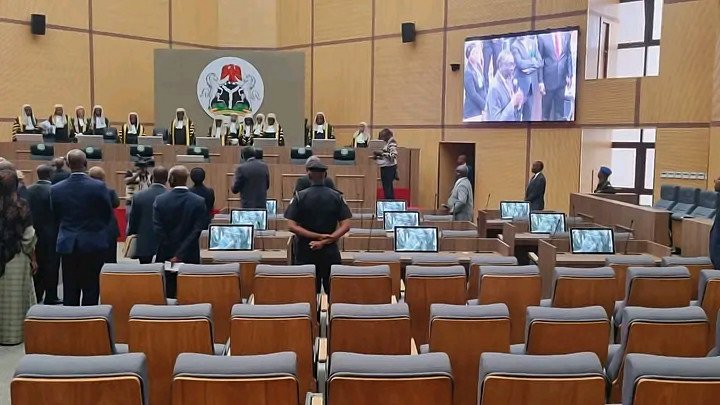
In a significant move to tackle the perennial backlog of cases and modernize Nigeria’s justice system, President Bola Ahmed Tinubu has formally requested the National Assembly to amend the Court of Appeal Act.
The proposed legislation, transmitted to both the Senate and the House of Representatives on January 27, 2026, seeks to drastically increase the court’s capacity and integrate digital innovations into appellate proceedings.
Understanding the Court of Appeal Act
The Court of Appeal Act serves as the primary statutory framework for the intermediate court between the High Courts and the Supreme Court. Established originally in 1976, the Act governs how the court operates across its various divisions in the federation.
Core Provisions of the Current Act:
- Establishment & Jurisdiction: It establishes the Court of Appeal as the penultimate court, hearing appeals from the Federal High Court, State High Courts, National Industrial Court, and various tribunals (including Election Petition Tribunals).
- Composition: Under the existing 2013 amendment, the statutory limit for Justices of the Court of Appeal is set at 70.
- Quorum: For a valid sitting, the Act requires a minimum of three Justices to hear and determine an appeal.
- Precedence: It outlines the ranking of the President of the Court of Appeal (PCA) and other Justices, ensuring a clear administrative hierarchy.
- Process & Execution: It mandates that the court’s processes run throughout the Federation and that its judgments are enforceable in the same manner as High Court rulings.
The President’s Proposed Amendments (2026)
President Tinubu’s new bill seeks to replace outdated sections of the Act to reflect “current realities” and “modern institutional standards.” The proposed changes are centered on four key pillars:
1. Massive Bench Expansion
The most striking amendment is the proposal to increase the number of Justices from 70 to 110. The President noted that the current number is insufficient to handle the “growing volume and complexity of appeals,” which often leads to litigants waiting years for a hearing.
2. Virtual Proceedings & Digitalization
In a push for a “paperless” and more accessible judiciary, the bill introduces:
- Electronic Hearings: Explicit legal recognition for proceedings conducted via audio-visual and electronic means.
- Modern Terminology: Updating the Act to include digital definitions and modern “correctional nomenclature” (replacing old “prison” references).
3. Alternative Dispute Resolution (ADR) Center
The President has proposed the establishment of a dedicated Alternative Dispute Resolution Center within the Court of Appeal. This would allow certain appellate matters—particularly commercial or civil disputes—to be settled through mediation rather than full adversarial litigation, further decongesting the court dockets.
4. Clarifying Seniority and Ranking
To prevent administrative friction, the bill seeks to restructure provisions regarding the ranking and precedence of Justices. This includes clearer rules on how seniority is determined and the specific status of the President of the Court in relation to other judicial heads.
The Court of Appeal (Amendment) Bill, 2026 has been referred to the relevant committees in both chambers. Lawmakers are expected to deliberate on the financial implications of hiring 40 new Justices, including their welfare, housing, and the creation of additional courtrooms to accommodate the expanded bench.