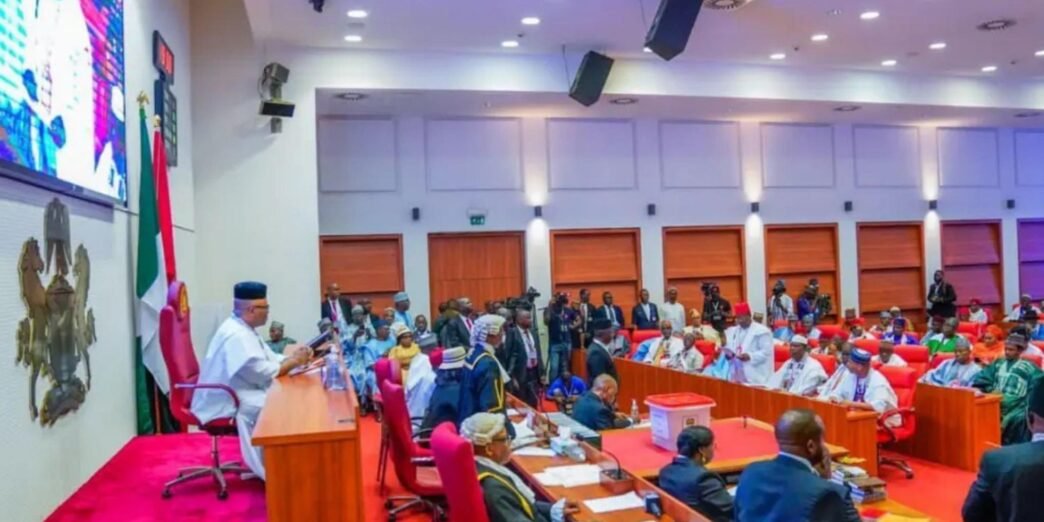
In a decisive move to strengthen Nigeria’s democratic framework, the Senate has officially passed amendments to the Electoral Act 2026. The new legislation designates the Court of Appeal as the final arbiter for pre-election disputes involving Governorship, National Assembly, and State House of Assembly elections, effectively curbing prolonged legal battles that often overshadow the general polls.
Sponsored by Senator Simon Bako Lalong (Plateau South), the bill passed its second and third readings during plenary today. The primary objective of the amendment is to eliminate “forum shopping” and the trend of contradictory judgments from courts of coordinate jurisdiction. By assigning specific jurisdictional competence, the Senate aims to ensure that the legal status of every candidate is resolved with finality before citizens head to the ballot box.
Key provisions of the amendment include:
Finality of the Court of Appeal: The appellate court now serves as the terminal point for all pre-election matters concerning State and National Assembly, as well as Governorship contests.
Presidential Disputes: The Court of Appeal is empowered to hear pre-election matters regarding Presidential and Vice-Presidential candidates as a court of first instance, with final appeals proceeding directly to the Supreme Court.
Jurisdictional Clarity: Amendments to Section 29 allow aspirants to institute legal actions either in the Federal Capital Territory or the specific jurisdiction where the cause of action originated, providing clear channels for litigation.
Leading the debate, Senator Lalong emphasized that the credibility of an election is tied to the predictability of its legal processes.
“Where the legal framework regulating pre-election disputes is uncertain or conflicting, the entire electoral architecture becomes vulnerable to confusion and unnecessary delays,” Lalong stated.
Echoing this sentiment, Senator Ekong Sampson (Akwa Ibom South) and Senator Adams Oshiomhole (Edo North) lauded the bill as a necessary intervention to protect the political space from the dangers of inconsistent judicial outcomes. They noted that the move would restore public confidence in electoral adjudication and ensure that party primaries remain the foundational pillars of representative democracy.
The Senate’s resolution follows a similar amendment passed by the House of Representatives last week, co-sponsored by Deputy Speaker Benjamin Kalu and several committee chairmen. With both chambers in alignment, the amendment to Section 29 of the Electoral Act 2026 establishes a uniform standard for resolving internal party disputes and candidate nomination crises across the federation.
The passage of this bill marks a significant milestone in Nigeria’s legislative history, prioritizing judicial efficiency and the timely delivery of justice in the nation’s quest for electoral stability.